" height="39.61165048543689px" id="ZNWWQDUsB" transform="translate(0 0.195)" width="39.79498837473122px"/><path d="M 14.36 13.33 C 15.643 13.33 16.374 11.864 15.601 10.841 L 7.888 0.619 C 7.048 -0.494 5.28 -0.022 5.107 1.362 L 4.627 5.196 C 4.496 6.248 4.009 7.224 3.248 7.963 L 0.475 10.653 C -0.526 11.624 0.161 13.32 1.555 13.321 Z" fill="rgb(255, 87, 199)" height="13.329661963960334px" id="BFIxPoook" transform="translate(3.344 8.474)" width="15.91740701520282px"/></svg>)
When we say design and construction are converging, it is less a slogan and more a reckoning.
For decades, the design process has treated construction as the afterparty, the place where feasibility, cost, and coordination finally catch up. But by the time a drawing set reaches a contractor, most of the decisions that shape cost and constructibility are already locked. That gap is not a technical problem. It is a cultural one.
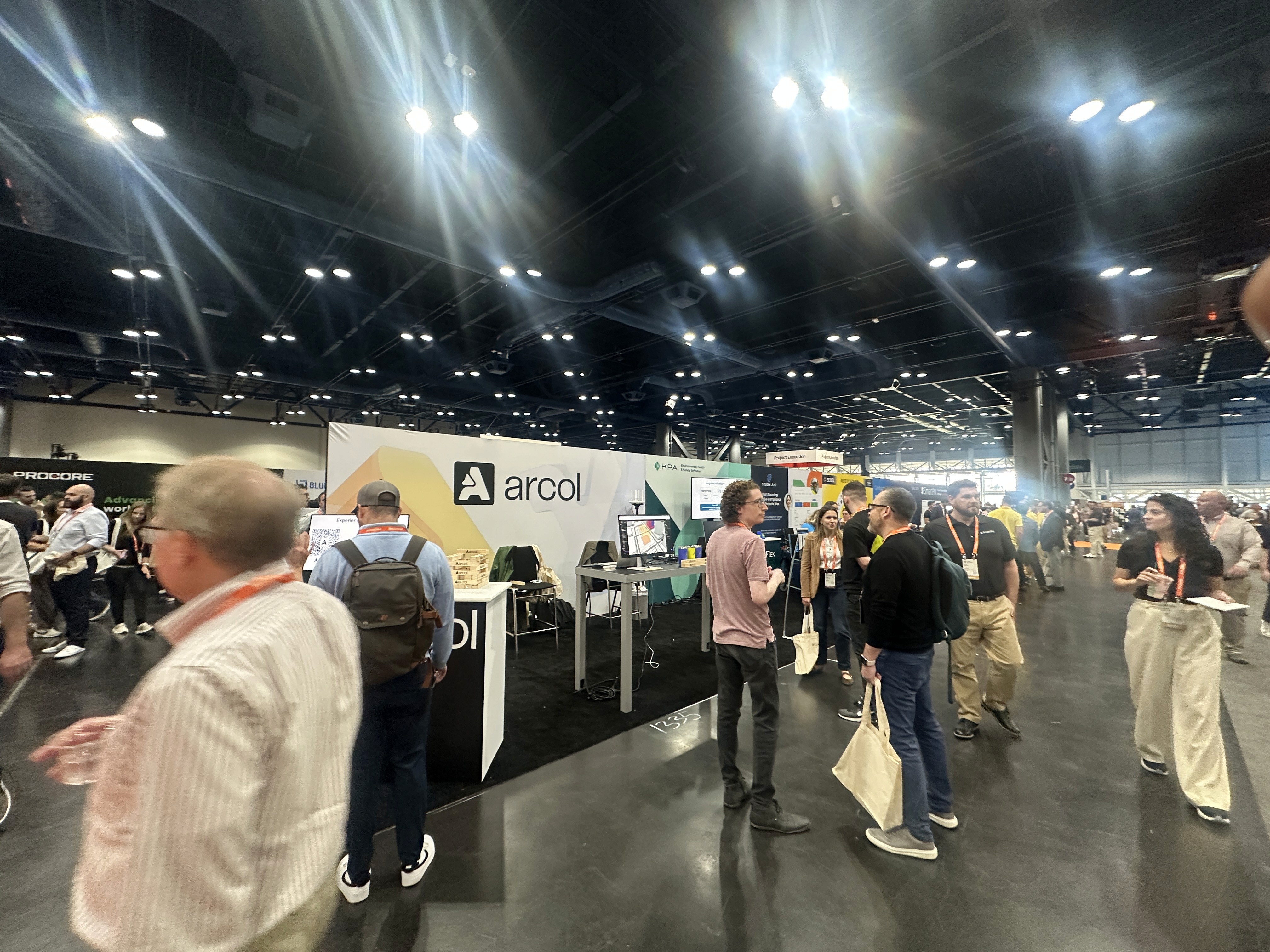
Design tools have long assumed that design comes first and everything else follows. But as our CEO, Paul O’Carroll reflected, after attending Procore Groundbreak, “the future of design does not start with design”. It starts with conversation; the kind where the architect, the owner, and the GC are all in the same room, or better yet, the same model, from day one.
Cost as the New Canvas
Builders are bringing data to the table earlier than ever. Material volatility, labor shortages, and embodied carbon are not afterthoughts anymore. They are design inputs.
That is the shift. The line between feasibility and creativity is blurring. And it is a good thing. Because design without constructibility is just imagination.
We are watching the same pattern that transformed software play out in AEC. Engineers used to be downstream from design, siloed alongside product managers. Then tools like Figma and Bluebeam made collaboration the default. Now, construction is following that arc.
The design conversation is expanding. It includes more voices, more data, and more context. That is not the death of design. That is its evolution.
Design’s Next Superpower: Integration
Designers once worried that bringing contractors in too early would constrain creativity. The opposite is true. When cost, schedule, and constructibility live inside the same conversation, creativity expands because the constraints are visible, dynamic, and real.
The architect is no longer the sole author. They are the orchestrator. The GC is not a gatekeeper. They are a co-creator.
And the tool that brings them together is not a CAD program or an estimating platform. It is the shared model, live, multiplayer, and accessible.
What we are Building Toward
At Arcol, we are building for that reality. A world where design, cost, and constructibility do not happen in sequence, but in sync.
Where architects model ideas that builders can immediately price and owners can instantly understand. Where feedback is not an RFI months later, but a comment in real time.
Design is not dead. It is growing up.
And the firms, and platforms, that understand this convergence first will define the next decade of building.
The future of design does not start with design. It starts with everyone who touches it.