" height="39.61165048543689px" id="ZNWWQDUsB" transform="translate(0 0.195)" width="39.79498837473122px"/><path d="M 14.36 13.33 C 15.643 13.33 16.374 11.864 15.601 10.841 L 7.888 0.619 C 7.048 -0.494 5.28 -0.022 5.107 1.362 L 4.627 5.196 C 4.496 6.248 4.009 7.224 3.248 7.963 L 0.475 10.653 C -0.526 11.624 0.161 13.32 1.555 13.321 Z" fill="rgb(255, 87, 199)" height="13.329661963960334px" id="BFIxPoook" transform="translate(3.344 8.474)" width="15.91740701520282px"/></svg>)
AI and generative design in AEC
AI and generative design tools are reshaping architectural practice. At Arcol, we're building systems that make these technologies work for architects—not the other way around. We explored this evolution in our previous post, The Arcol Roadmap: Part 2, but let’s dive deeper into what this means for firms today.
Key Takeaways
Efficiency & Growth: Evaluate AI tools based on tangible results ie. they save time or help win new business.
AI vs. Generative Design: AI (Machine Learning) acts as a pattern finder and predictor, while Generative Design acts as a creator and optimizer.
Data is the "Secret Sauce": A firm's historical project data is its competitive advantage; structuring this data is essential for AI adoption.
Parametric Frameworks: Advanced parametric design captures design intent and history, creating the structured datasets needed for AI training.
The future of architectural design technology
Architects often ask: should we be using AI or generative design in our process?
We believe that both AI and generative design have an important role to play in the future of our industry and also for our product. But we feel strongly that architects shouldn’t just use tech for tech’s sake. At the end of the day, there are two main questions you and your team should be asking yourselves when it comes to these technologies:
Across the profession, excitement about AI is matched by a healthy dose of caution—architects are "evenly split in their enthusiasm and wariness about the new technology". That means the conversation can’t just be “should we use AI?”—it has to be “where does it move the needle for our practice?”.
But architects shouldn't use tech for tech's sake. When evaluating these technologies, you and your team should ask two questions:
Are they saving us time / making our process more efficient?
Are they helping us win business?
Before we dive further into these questions, let’s take a minute to review what the difference is between AI – specifically machine learning (ML) – and generative design.
AI vs. generative design in architecture
"You can think of machine learning as a pattern finder and generative design as a creator [...] While machine learning is used to analyze and predict, generative design creates and generates." - Generative Design Primer
Machine learning (ML): You typically start with a large dataset. The computer finds patterns, forms relationships, creates rules, and predicts new outcomes.
Generative design (GD): Designers set initial parameters and measurable objectives. The computer runs genetic algorithms to produce, evaluate, and rank hundreds of options against those goals.
Generative design is a subset of computational design where designers define initial parameters and quantifiable objectives. The computer then uses genetic algorithms to generate hundreds or thousands of options, evaluates them against the designer’s objectives, iteratively improves them based on previous results, and ranks them by how well they meet the original goals.
Now we can answer those two questions: how do you save time and win business?
The key is identifying specific use cases for AI and generative design that leverage your firm's competitive advantage—the unique knowledge and processes that define your practice. This starts with your internal firm data. Structured properly, this data enables AI and generative design to accelerate your workflows and deliver measurable value: faster iterations, better decisions, and clearer client communication.
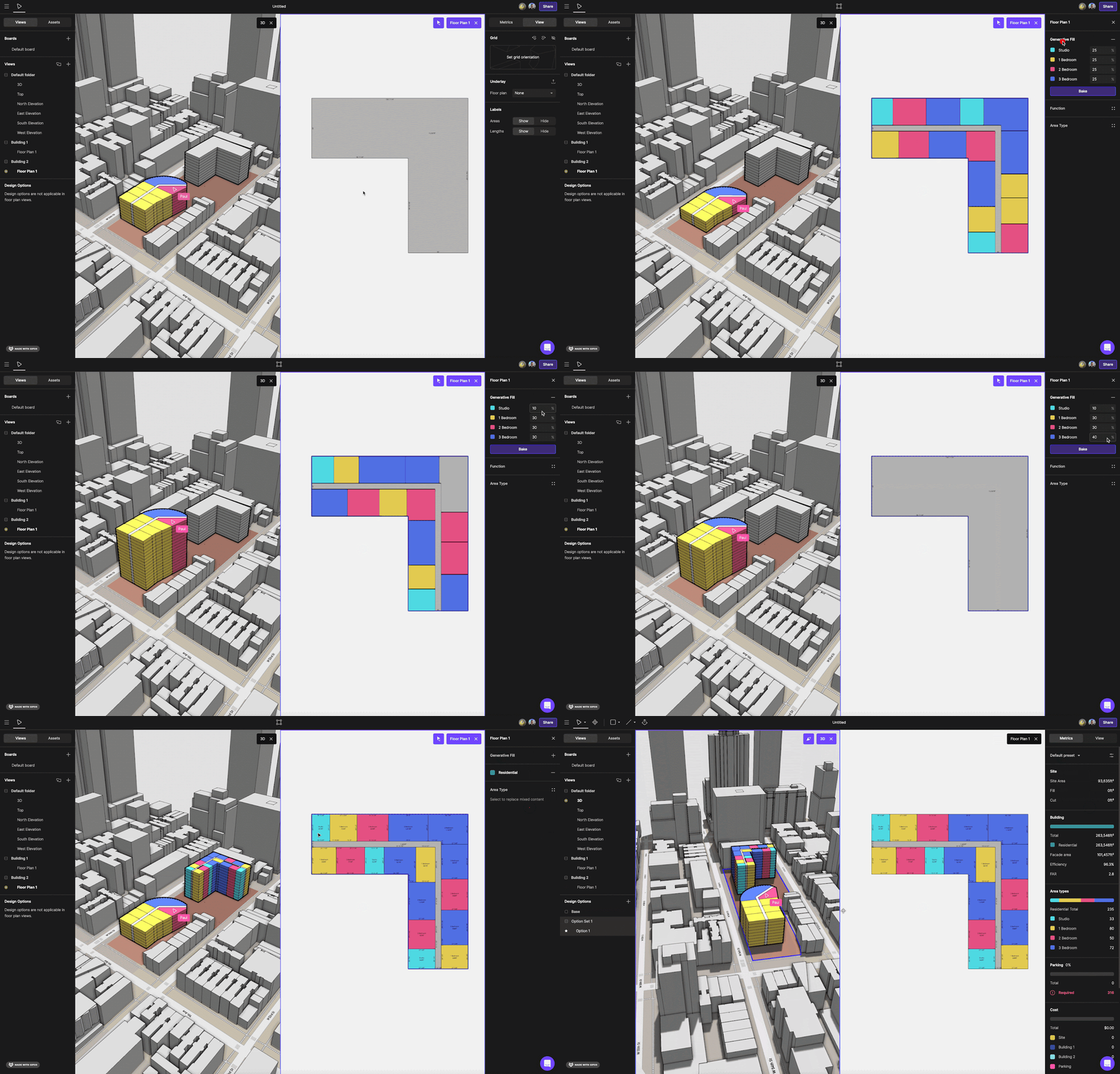
Arcol’s multiplayer generative design helps teams explore floor plan options together, automatically creating unit layouts and corridors to your requirements – turning your design knowledge into actionable solutions.
Leveraging your firm’s data for design innovation
Every architecture firm has accumulated years of knowledge: design decisions, process refinements, and project outcomes. This internal data represents your firm's competitive advantage—the expertise that differentiates your practice. Using generic AI models trained on other firms' data means losing that differentiation.
The challenge is that architectural practice involves complex, interconnected decisions—from facade design to drawing set management to project billing. That internal, historical data needs to be cleaned and structured to enable generative design and AI to deliver concrete value: faster design iterations, validated decisions, and optimized solutions.
Imagine being able to analyze all your past facade designs to understand which combinations of materials, patterns, and openings performed best for different building types and orientations—enabling faster, more informed design decisions on future projects. This is the kind of innovation that becomes possible when your recipe – your firm’s unique approach – is translated into structured data.
How do you structure your data to enable these capabilities?
Advanced parametric design builds a framework for success
The key is advanced parametric design systems that go beyond basic 3D modeling. These platforms capture not just geometry, but the entire modeling history and relationships between design elements. This makes them powerful tools for standardizing and structuring diverse architectural data.
Modern parametric systems transform messy, heterogeneous project data—whether from Rhino, Revit, AutoCAD, or other platforms—into structured datasets. These datasets capture not just form, but design intent, performance metrics, and success patterns.
In practice, this creates a powerful feedback loop: as architects work on new projects using these advanced tools, they can benefit from AI assistance informed by their firm’s collective experience – suggesting initial parameters, optimizing constraints, and generating design alternatives. Such systems can accelerate routine tasks, validate design decisions against historical performance data and building codes, and help architects focus on what they’re best at: being creative and solving complex spatial problems for their clients. This approach will make firms more competitive by enabling rapid iteration, data-driven decision making, and the clear demonstration of value to clients through proven performance metrics and optimized solutions.
From Design Data to Competitive Advantage
AI Assistance: Suggestions for initial parameters and optimized constraints based on collective experience.
Task Acceleration: Automating routine tasks to focus on creative problem-solving.
Automated Validation: Checking design decisions against building codes and historical performance data.
Competitive Iteration: Rapidly generating alternatives to demonstrate value to clients through proven metrics.
From design data to competitive advantage
The result is a framework that not only makes individual architects more efficient and helps firms systematically learn from and improve upon their past work. This creates competitive advantage: combining architectural expertise with AI's analytical power, grounded in real-world project data.
As the AEC industry continues to evolve, firms that can effectively implement these kinds of systems will be ahead of the curve when it comes to delivering better projects more efficiently and winning more business in an increasinglywin more business in a competitive market.
You don't need perfectly structured data to start this process.
Arcol captures structured data naturally during your design process—no separate data cleaning required. More structured data, less extra effort. Our parametric modeling approach creates structured data by default, enabling AI and generative design capabilities as your project library grows.
The question isn't AI or generative design—it's how to use both effectively. If your firm structures internal data now, you'll have the flexibility to leverage AI and generative design as these technologies mature—on your terms, with your competitive advantage intact.
If your firm is exploring AI and generative design, we can help you structure your approach. Learn more about how Arcol supports architects and designers.
Frequently asked questions
What’s the difference between AI and generative design?
AI (machine learning) looks at past project data to find patterns and predict outcomes. Generative design starts with the goals you set—like unit count or daylight targets—then lets the computer create, test, and rank hundreds of options. Think of AI as the analyst and generative design as the creator.
Will AI replace architects?
No, we don't believe so. AI automates routine steps, but only architects can balance creativity, context, and ethics. Use AI to handle the busywork so you can focus on design thinking and client guidance.
What is the 30 % rule in AI and how does it apply to architecture?
The 30 % rule suggests AI should cover roughly one-third of a task—things like data checks, early layout studies, or schedule updates—while architects focus on the creative 70 %. It’s a reminder to use AI as support, not a substitute.
How can my firm prepare its data for AI and generative design?
Collect past project files in one shared folder.
Remove duplicates and fix obvious errors.
Add simple tags like building type, floor area, and key materials.
Save files in open or well-documented formats.
Clean, labeled data helps AI spot patterns and lets generative tools build better options from your own “recipe.”